
7♠7♥7♣
Weakest Trail tier — still beats every non-Trail hand.
Gallery
Teen Patti Trail examples
These Teen Patti Trail examples show four common trios: three 7s, three 9s, three Jacks, and three Aces. Every Trail uses exactly three cards of the same rank — suits can differ. Ace Trail is the strongest trio; seven Trail is weaker but still rank #1.
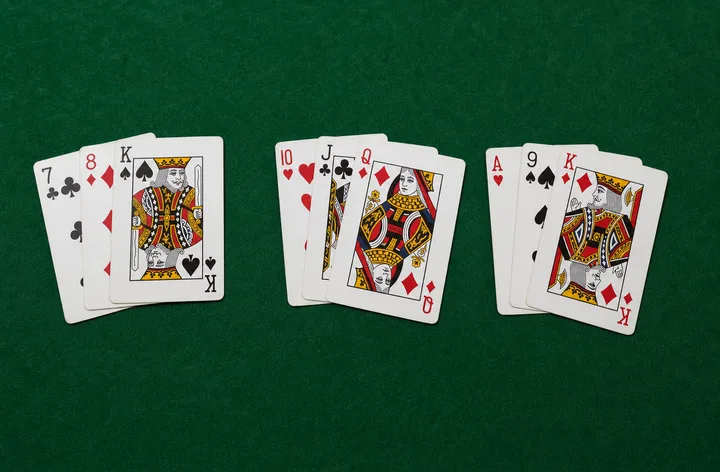
Four trios
Trail examples with card panels
9♥9♠9♦
Mid-tier trio — beats nines Pair and all lower ranks.
J♠J♥J♣
Strong trio — loses only to Queen, King, or Ace Trail.
A♠A♥A♣
Highest Trail — see highest Trail page.
Trail vs Trail
Compare two Trails
Higher rank wins: J-J-J beats 9-9-9. Identical Trails may split the pot per house rules.
| Hand A | Hand B | Winner |
|---|---|---|
| A-A-A | K-K-K | A-A-A |
| J-J-J | 7-7-7 | J-J-J |
| 9-9-9 | Pure Sequence | 9-9-9 Trail |
Friends table
Social practice notes
When practicing Teen Patti Trail examples, write house rules first: boot, blind/seen multiple, side-show, and tie-breakers. Run one beginner round naming hand ranks only — it reinforces the ladder without heavy pot pressure.
On app or at home, virtual chips are counters only. Never link outcomes to cash, UPI, or withdrawals. Invite 18+ adults only. Review the hand chart if players disagree at show.
Compare uncertain hands on the ranking chart and restate house rules aloud before each new round. If two players disagree at show, pause and read the ladder together instead of arguing from memory.
House-rule reminder
Confirm ace-low sequences, side-show limits, and tie-breakers aloud before the first deal. Social practice uses virtual chips only — no cash framing, no withdrawal talk, 18+ adults at the table.
Need the full ladder?
Open the hand ranking chart or rules FAQ.